Eight months ago, I dropped $380 on Facebook ads for a silicone pet grooming glove I’d seen blowing up on TikTok. My plan felt bulletproof: use ChatGPT to write a killer product description, throw together a Shopify store in an evening, let AI-generated ad creatives do the heavy lifting, then sit back.
I made two sales. Both customers asked for a refund because the glove that showed up looked nothing like the one in my ad.

That was my real introduction to AI dropshipping, and it looked nothing like the YouTube thumbnails with private jets and “I made $10k while I slept” captions. It looked like me, at 1 am, refreshing my Shopify dashboard and wondering if I’d just set money on fire.
I kept going anyway, mostly out of stubbornness. A year or so later, I run a small store that turns a real, if unglamorous, profit most months, and I’ve got a much clearer sense of where AI genuinely helps in this business and where it’s just marketing dressed up as a shortcut. If you’re thinking about trying this yourself, here’s what I’d actually tell you over coffee, not what a course is trying to sell you.
So What Does “AI Dropshipping” Actually Mean?
Quick reality check before the how-to part, because the term gets thrown around loosely.
Dropshipping itself isn’t new. You list a product on your own store, a customer buys it, and instead of you packing and shipping it yourself, a supplier ships it directly to them. You never touch or store the product.
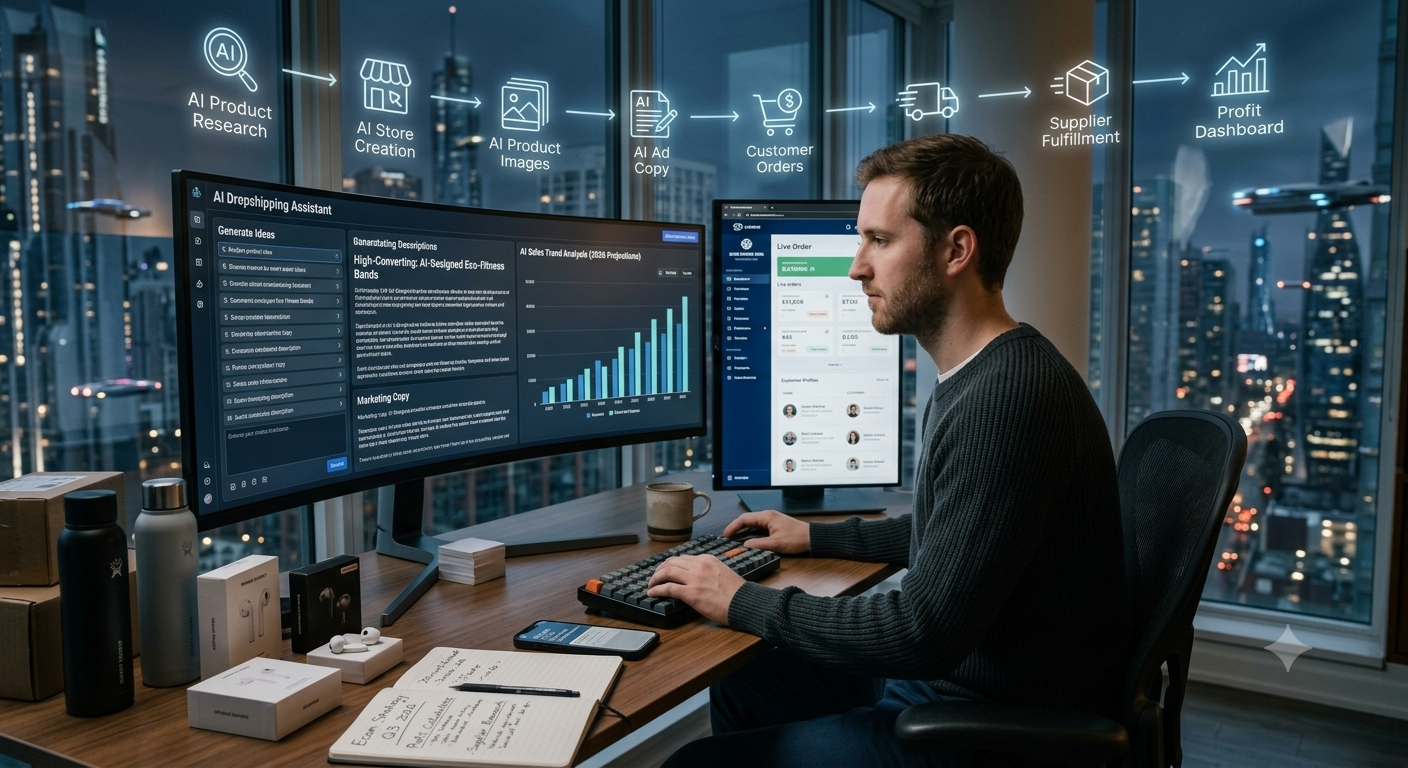
“AI dropshipping” just means using AI tools to handle the slower, more repetitive parts of that process — finding products worth testing, drafting descriptions, generating ad variations, answering customer questions at 2 am so you don’t have to.
It does not mean an AI runs the business for you. I genuinely wish it did. What it actually does is take a task that used to eat three hours of my evening and shrink it to twenty minutes, which matters a lot when you’re doing this around a day job.
The Tools That Actually Stuck Around In My Workflow
I paid for way too many subscriptions in month one and used maybe half of what I signed up for. Here’s what earned a permanent spot:
For product research, I go back and forth between Dropship.io and Sell The Trend. Both show you what’s genuinely selling on other real Shopify stores instead of just guessing off what’s trending on social media, which is exactly the mistake I made with the pet glove. Sell The Trend’s ad-spy feature is handy for seeing what creative competitors are already running before you copy their homework blind.
For the store itself, I’m still on Shopify. Their built-in AI tool, Shopify Magic, drafts product descriptions and basic email copy, and it’s gotten noticeably more capable since their recent updates added more automated admin features. I never publish its first draft as-is, but it beats staring at a blank page.
For product photos, I use Canva’s AI background and mockup tools to make supplier images look less like they were ripped straight off a marketplace listing. Not perfect, but a real step up from the default photos.
For customer support, Tidio’s free chatbot tier handles the repetitive “where’s my order” messages. It’s genuinely saved me from checking my phone every twenty minutes.

For writing, I use ChatGPT or Claude for first drafts of ad copy and product descriptions, then rewrite a good chunk of it myself. This step matters more than people assume, and I’ll get into why further down.
If you’re fulfilling through AliExpress at volume, DSers or CJdropshipping handle a lot of the order automation. If you’d rather use US or EU-based suppliers so customers aren’t waiting three weeks, Spocket and Zendrop are worth a look — Zendrop in particular has leaned hard into AI-generated video ads lately.
How to Actually Start (Step by Step)
1. Pick a niche you wouldn’t mind talking about for six months. I skipped this the first time. I picked pet products because one video was doing huge numbers, not because I knew or cared about pets beyond having a cat who mostly ignores me. When you don’t care about the niche, it shows up in your ad copy, your product choices, and your patience when something goes wrong. Second time around I picked home organization products, mostly because I’m a little obsessed with storage bins, and it made every other step easier.
2. Let AI help you brainstorm, then verify with real numbers. Ask ChatGPT or Claude for pain points, buyer personas, and marketing angles for a product idea — genuinely useful for this part. But don’t stop there. Run the actual product through a research tool like Dropship.io or Sell The Trend to see whether real stores are selling it and roughly how well. A product that only exists in your head and an AI’s suggestion isn’t validated yet.
3. Build a simple store. Don’t overthink the design. Shopify’s Basic plan runs about $39 a month ($29 if you pay annually), and they often run a promo with a short free trial followed by a few months at $1. Pick a clean, free, or cheap theme, use Shopify Magic for a first-draft product description, and you’re most of the way there. My first store had eleven pages nobody needed. My current one has four. Nobody has ever complained.
4. Sort out your supplier before you spend a cent on ads. This is the step I rushed, and it cost me. Order the product yourself first. Check how long it actually takes to arrive, what the packaging looks like, and whether it matches your product photos. If you’re using Spocket or Zendrop, this part is a bit easier since a lot of their suppliers are based in the US or EU, so you’re not gambling on a customer’s patience for three-plus weeks.
6. Test small before you test big. Start with a genuinely modest ad budget, something like $10 to $20 a day across a handful of creatives, before scaling anything up. AI video ad tools like Creatify or HeyGen can spit out several ad variations quickly, which is useful right at this stage, but treat what they generate as a rough draft to test, not a finished campaign.
7. Set up basic automation for support and fulfillment. A simple FAQ chatbot (Tidio’s free plan is enough at first), automatic shipping-update emails, and a clearly posted returns policy. None of this is glamorous, but it’s what keeps you sane once real orders start coming in.
8. Check your numbers weekly, not hourly. I used to refresh my Shopify analytics like a slot machine. It made me anxious and changed nothing about the outcome. Now I review performance once a week, decide what to kill and what to scale, and leave it alone the rest of the time.
9. Get the boring business basics sorted. Depending on where you live, this might mean registering as a sole trader or small business, understanding when you need to collect sales tax, and keeping business banking separate from personal. Rules vary a lot by country and state, so this is genuinely worth a short conversation with a local accountant rather than guessing. AI can write your product descriptions; it can’t file your taxes for you.
What This Looked Like In Practice: One Flop, One Win
The pet glove came from a viral TikTok video with almost no real research. I used a supplier I had never tested, and the product description was written by AI without making any edits. Two sales, two refunds, $380 gone.
A stackable drawer organizer set: found through Sell The Trend after I noticed a demand spike in a niche I already cared about, ordered a sample myself before listing it, rewrote every line of AI-drafted copy so it sounded like an actual person describing an actual messy junk drawer, tested with $15 a day across three ad creatives for five days before scaling anything. That one’s been profitable most months since. Nothing dramatic, but steady enough to cover a real chunk of my bills.
The difference wasn’t which AI tools I used — I used AI for both. The difference was doing the research, ordering the sample, and treating AI output as a first draft instead of a finished product.
Mistakes I’d Tell You to Skip
- Trusting a viral video as your market research. Viral doesn’t mean profitable, and by the time you spot a product trending, plenty of other sellers have too. That’s instant ad competition.
- Publishing AI-written copy without actually reading it. Customers can tell when a description sounds generic, and it converts worse than something that sounds like a real person actually used the product.
- Skipping the sample order. If you haven’t held the product yourself, you don’t really know what you’re selling.
- Spending big on ads before testing small. Scaling a weak ad just loses money faster than a small one does.
- Ignoring your supplier’s real shipping times. A great product with a five-week delivery window earns you chargebacks and bad reviews, not repeat customers.
- Stacking too many paid AI tools before your first sale. I paid for four subscriptions in month one and barely used half their features. Start with free tiers, add paid tools once you know exactly which bottleneck you’re solving.
- Forgetting it’s still a real business. Ad account reviews, refund requests, tax obligations — none of that disappears just because AI is involved somewhere in the process.
Is It Actually Worth Starting in 2026?
Honestly, AI didn’t make dropshipping easy. It made the repetitive parts faster, which freed up time for the stuff that actually decides whether you make money: picking something worth selling, treating customers like people, and not quitting after your first product flops.
If you’re going to give this a shot, keep your first month’s ad budget small enough that losing it wouldn’t actually hurt, and go in expecting your first product probably won’t be “the one.” Mine wasn’t. It rarely is for anyone.
That pet grooming glove is still sitting in a drawer somewhere in my apartment, a $380 reminder that no AI tool can replace ordering the sample yourself first. Worth starting? For me, yes. Just don’t expect it to run itself.